
Quick Answer
Parquet floor cleaning in Dubai means low-moisture, pH-neutral cleaning that removes sand and grit without letting water reach the joints, typically weekly dry care plus a professional deep clean every 12–18 months. Exterior wall cladding in Dubai must handle UV, salt-laden air and 50°C surface temperatures, which favours aluminium composite, fibre cement, WPC and natural stone over standard timber. A microcement display unit in Dubai is a seamless, 2–3 mm cement-polymer coated joinery piece used in retail and villa interiors for a monolithic concrete look without the weight. Risala Furniture and Interiors LLC delivers all three services in the UAE.
Key Facts Table
| Factor | Parquet Cleaning | Exterior Wall Cladding | Microcement Display Unit |
| What it is | Maintenance of timber block or plank flooring | External facade finish system | Thin cement-polymer coating on joinery substrate |
| Typical frequency / lifespan | Deep clean every 12–18 months | 15–40 years by material | 10+ years with sealer refresh |
| Indicative Dubai cost | AED 8–25 per m² professional clean | AED 150–900 per m² installed | AED 400–1,200 per m² of finished surface |
| Moisture rule | Barely damp mop only | Ventilated cavity recommended | Sealed, water-resistant when properly cured |
| Main risk | Water ingress at joints | Thermal movement and fixing failure | Substrate movement causing hairline cracks |
| Relevant standard | EN 13442 (wood floor cleaning resistance) | ASTM E1592, EN 13830 for facades | EN 13813 for cementitious screed materials |
Introduction
Dubai punishes finishes in three specific ways: fine airborne sand, intense UV, and a permanent temperature gradient between chilled interiors and superheated exteriors. Those three forces explain most maintenance failures in the city. This article covers the practical response in three areas that come up constantly in villa and retail projects, from keeping an existing parquet floor alive to specifying a facade that will not chalk in four years.
Parquet Floor Cleaning in Dubai: Doing Less, More Often
Why sand is the real enemy
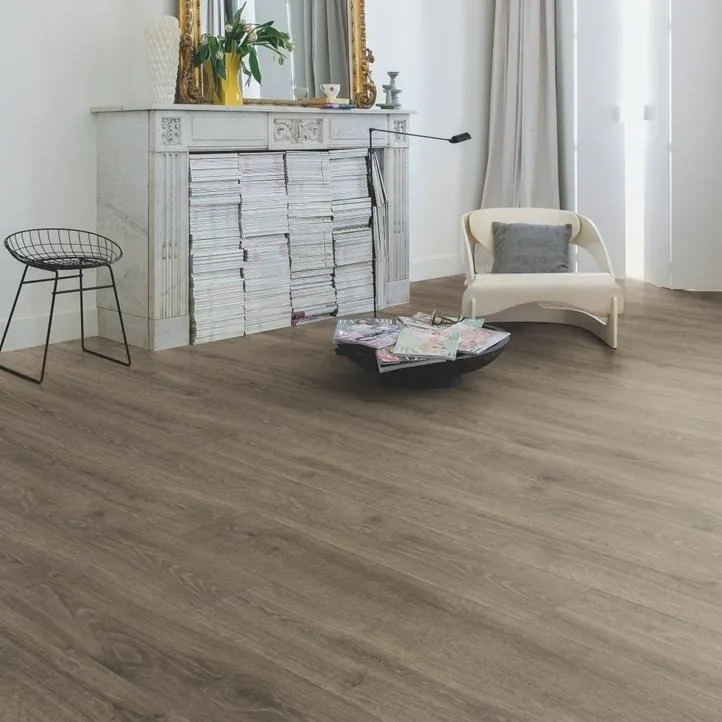
Fine desert sand acts as an abrasive. Every footstep grinds particles into the lacquer or oil layer, creating micro-scratches that dull the finish and eventually expose bare timber. The most effective maintenance in the UAE is therefore frequent dry removal rather than occasional wet cleaning.
The weekly routine
- Dry vacuum with a hard-floor head (no rotating beater bar) two or three times per week.
- Microfibre dust mop daily in entrance zones and corridors.
- Damp mop, barely wet, once a week using a pH-neutral wood floor cleaner. The mop should leave the floor dry within 30 seconds.
- Never use steam mops, vinegar solutions, ammonia-based products, or oil soaps on lacquered parquet.
- Entrance matting of at least 1.2 m length traps most grit before it reaches the floor.
Lacquered versus oiled parquet
Lacquered floors have a sealed surface film. Damage sits on the surface and repairs mean recoating an entire area. Oiled floors absorb the finish into the timber, so scratches can be spot-repaired with maintenance oil, but they need re-oiling roughly every 12–24 months in high-traffic zones.
When to call a professional
- The floor looks hazy or cloudy after mopping, indicating residue build-up.
- Dark patches appear along joints, indicating water ingress.
- Boards feel rough underfoot, indicating finish wear.
- Squeaks develop, indicating loosened blocks in traditional parquet.
Professional parquet restoration follows a defined sequence: assessment, dust-free sanding at successive grits, gap filling, sealing, then two or three finish coats. Risala Furniture and Interiors LLC uses dust-extraction sanding systems, which matters in occupied villas where fine wood dust otherwise circulates through the air conditioning for weeks.
Exterior Wall Cladding in Dubai: Specifying for the Climate
Material comparison
| Cladding Material | Indicative cost per m² | Expected life | Key strength | Watch out for |
| Aluminium composite panel (ACP) | AED 220–450 | 20–30 years | Lightweight, flat, wide colour range | Must be fire-rated core (A2 or FR grade) |
| Fibre cement board | AED 180–380 | 30–50 years | Excellent fire and weather performance | Heavy; edges need sealing |
| WPC (wood plastic composite) | AED 150–320 | 10–20 years | Timber look, low maintenance | Colour fade if not UV stabilised |
| Natural stone | AED 400–900 | 40+ years | Premium appearance, thermal mass | Weight, fixing design, cost |
| Terracotta / ceramic rainscreen | AED 350–700 | 30–50 years | Colour stability, ventilated system | Longer lead times |
| HPL (high pressure laminate) | AED 250–500 | 15–25 years | Sharp finishes, graphic options | Thermal movement allowance needed |
Fire regulations are the first filter
Following updates to the UAE Fire and Life Safety Code of Practice, external cladding on buildings must meet defined fire performance requirements. Combustible-core panels are no longer acceptable in most applications. Always request the fire classification certificate and confirm the system, not just the panel, has been tested. Dubai Civil Defence approval is a project requirement, not an optional extra.
Ventilated rainscreen principles
The best-performing facades in Gulf conditions are ventilated systems: cladding panel, air cavity of 25–50 mm, insulation, then the structural wall. The cavity allows heat to escape by convection, reducing cooling load, and lets any wind-driven moisture drain away. It also decouples thermal movement of the panel from the building structure.
Fixing and movement
Aluminium expands roughly 2.3 mm per metre per 100°C change. Across a 4 m panel facing full summer sun, that is real movement. Slotted fixings, correct joint widths and compatible sealants are what prevent the buckling visible on poorly detailed facades around the city.
Microcement Display Units in Dubai: Seamless Without the Weight
Microcement is a polymer-modified cementitious coating applied in layers totalling around 2–3 mm. Because it is thin and adheres to plywood, MDF, plasterboard and existing tile, it can transform joinery without structural loading.
Where it works in display and retail
- Retail display plinths and counters where a monolithic concrete look is wanted without the weight limits of precast.
- Villa TV feature units and media walls with continuous surfaces and no visible joint lines.
- Reception desks in offices and clinics, where seamlessness reads as premium.
- Shelving and niche linings where corners need to be visually continuous.
The build-up, layer by layer
- Substrate preparation and moisture check.
- Primer suited to the substrate type.
- Fibreglass mesh embedded in a base coat to resist hairline cracking.
- Two base layers of microcement.
- Two finish layers, trowelled to the chosen texture.
- Sanding between coats.
- Two to three coats of sealer, typically a polyurethane or water-based system.
Total application time for a display unit is usually three to five days, with full cure over seven to ten days before heavy use.
Finishes and honest expectations
Microcement is a hand-applied finish. Trowel marks, tonal variation and subtle cloudiness are characteristic of the material, not defects. Anyone promising a perfectly uniform factory-flat surface is describing a different product. Risala Furniture and Interiors LLC prepares sample boards before application so clients approve the texture and tone in advance.
Actionable Tips
- For parquet: place felt pads under all furniture legs and replace them every six months. Grit embeds in old pads and turns them into sandpaper.
- For parquet: keep indoor humidity between 40% and 60% to limit seasonal gapping.
- For cladding: insist on a system fire test report, not just a material certificate.
- For cladding: schedule a facade wash twice a year in coastal areas to remove salt deposits.
- For microcement: reseal display surfaces every two to three years in retail, less often at home.
- For microcement: avoid abrasive pads and acidic cleaners, which strip the sealer.
Bringing It Together
These three services touch different parts of a property but share one principle: the substrate and the maintenance regime matter more than the surface product. Risala Furniture and Interiors LLC approaches all three the same way, starting with an on-site condition survey rather than a catalogue selection.
You can find the team through the Risala Furniture and Interiors LLC Google Maps location.
FAQ
1. How often should parquet floors be cleaned professionally in Dubai? Every 12 to 18 months for residential floors, more often in villas with sand exposure or heavy traffic.
2. Can I use a steam mop on parquet? No. Heat and moisture drive water into the joints and can lift or cup the wood.
3. How much does parquet sanding and refinishing cost in Dubai? Typically AED 45–120 per square metre depending on floor condition, the number of grit passes and the finish specified.
4. What is the best exterior wall cladding for Dubai’s climate? Fibre cement and fire-rated aluminium composite are the most common balanced choices. Ventilated rainscreen systems outperform direct-fixed systems on heat and moisture.
5. Does exterior cladding reduce cooling costs? A ventilated cladding system with insulation reduces heat gain through the wall, which lowers air conditioning load. Actual savings depend on orientation and insulation thickness.
6. Is microcement waterproof? Once sealed, it is water resistant and suitable for splash areas. For full wet-room use, a separate waterproof membrane is applied beneath it.
7. Will microcement crack? Hairline cracking can occur if the substrate moves. A fibreglass mesh layer and a rigid, well-braced substrate prevent most of it.
8. Can microcement be applied over existing tiles or laminate? Yes, over sound tiles with proper primer. Laminate and melamine surfaces need abrasion and a specialist bonding primer.
9. How long does a microcement display unit take to complete? Three to five days for application, plus around a week to full cure.
10. Where does Risala Furniture and Interiors provide its services? Risala Furniture and Interiors LLC provides its services in UAE ,OMAN , QATAR , SAUDI ARABIA , KUWAIT , BAHRAIN and all across the Gulf and Middle East region.
Key Takeaways
- Frequent dry cleaning protects parquet in Dubai far better than occasional wet cleaning.
- Fire classification is the first filter when choosing exterior wall cladding in the UAE.
- Ventilated rainscreen construction manages both heat and moisture better than direct fixing.
- Microcement gives a seamless concrete look on lightweight joinery, with hand-applied character.
- Substrate condition determines the outcome in all three disciplines.
Conclusion
Protect what you have before replacing it. A tired parquet floor is usually restorable at a fraction of replacement cost, an ageing facade usually needs a system review rather than a repaint, and a dated display unit can be resurfaced in microcement without demolition. Start each project with a condition survey, request documentation, and agree the maintenance regime up front. Risala Furniture and Interiors LLC covers survey, restoration and installation across Dubai.
